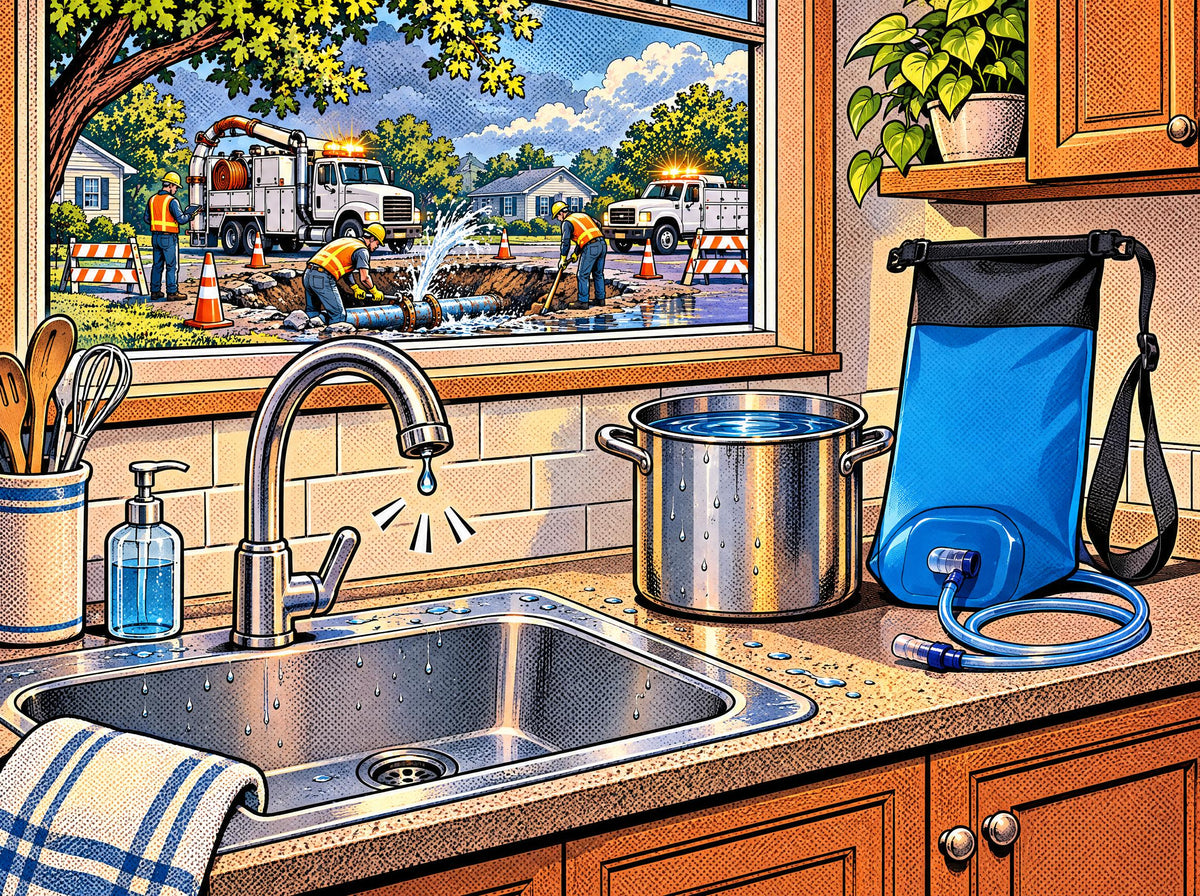
Water main break
The tap runs dry
A broken main or a failed pumping station can cut a whole neighborhood off for a day or more. The water you stored in the tub needs a clean way out.

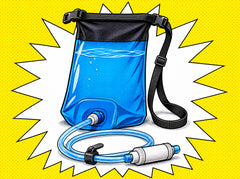
Hang, fill, wait. Clean water from a stream, without power or pumping.
 Gravity-fedNo pumping, no batteries
 0.01-micron filterBlocks bacteria and protozoa
 Folds flatFits a go-bag or a drawer
 1 gallon at a time3.8 liters per fill
The water to store per person, per day. After three days without a tap, it runs out.
Source: Ready.govDelivered in 5 to 14 days, tracked.
No. This filter is rated for bacteria (like E. coli and Salmonella) and protozoa (like Giardia and Cryptosporidium). It does not remove viruses, chemicals, heavy metals or salt. Use it with freshwater sources such as streams, rivers and rainwater.
Up to 4,000 liters according to the manufacturer, which is roughly 1,000 gallon bags. After that, replace the filter element.
The manufacturer rates the filter at 300 mL per minute, which is about 13 minutes per gallon bag with clear water. Cloudy water takes longer.
Yes. The kit filters water into whatever clean container you place below the hose outlet. A water bottle, a pot or a bucket all work.
5 to 14 business days. Every order ships with tracking, sent to you by email.
You have 30 days from delivery to return it for a refund. The full steps are in our Refund and Return Policy.
Hang the bag higher than your glass and open the clamp. The weight of the water does the pushing, through a membrane with 0.01-micron pores.
Manufacturer specification
By design
Flow rate and pore size are manufacturer specifications. Not rated for viruses, chemicals, heavy metals or salt water.
Ready.gov says to plan on one gallon per person, per day. Drag to the size of your household and see what a 72-hour outage takes.
One gallon per person per day is the Ready.gov planning figure for drinking and basic hygiene. Filter life is a manufacturer specification.
The first two come from Ready.gov. The last two come from the filter manufacturer.
1
gallon
What each person needs per day for drinking and basic hygiene.
Ready.gov
12
gallons
What a family of four needs to get through three days.
Ready.gov: 1 gallon per person per day
4K
liters
One filter is rated for up to 4,000 liters, about 1,050 gallons.
Manufacturer specification
0.01
micron
Pore size of the ultrafiltration membrane.
Manufacturer specification
When the tap slows down, there is still water around you: the rain barrel, the bathtub you filled before the storm, a stream. Fill the bag from any of them and let the filter do its part.
There is no pump to charge and no batteries to find in the dark. Hang the bag on a hook, a branch or a cabinet handle and the water runs through on its own.
Twelve gallons of bottled water weigh about 100 pounds and fill a closet shelf. The kit folds flat, weighs under a pound and waits in a drawer next to the radio.
No mystery box. Here is what is inside and what it does.

| Filter type | Ultrafiltration membrane, 0.01 micron, with a 1-micron pre-filter layer |
|---|---|
| Removes | Bacteria and protozoa, which are larger than the 0.01-micron pores |
| Does not remove | Viruses, chemicals, heavy metals, salt |
| Bag capacity | 1 gallon (3.8 liters) |
| Filter life | Up to 4,000 liters |
| Flow method | Gravity-fed through hose with flow clamp |
| Power needed | None |
| Bag material | BPA-free, food-grade |
| Packed size | Folds flat for storage |
| Flow rate | About 300 mL per minute (manufacturer specification) |
| Shelf life | 5 years, stored dry indoors at room temperature |
There is nothing to install and nothing to learn. This is the whole routine.

Collect
Open the roll-top, fill from any freshwater source, and hang it from a branch, hook or nail.

Filter
Filtered water flows through the hose into whatever clean container you place below. Use the clamp to stop the flow when switching bottles.

Drink
One gallon covers several refills. Plan for about 13 minutes per bag with clear water, longer if it is cloudy, then repeat.
An outage is one problem. The water is a second one, and it arrives later.
City systems usually hold pressure with towers and backup pumps, so nothing looks wrong yet. Homes on a private well stop getting water once the pump loses power.
With the radioFill the bag, the pots and the bathtub while the pressure is still there.
In a long outage, pumping stations may be running on limited backup power. Lower pressure is the first sign, especially on upper floors.
With the radioYou already have water stored, and a way to filter more from the tub or a barrel.
When pressure falls, utilities often tell customers to boil tap water. That is hard to do on an electric stove with no power.
With the radioFollow the notice. The filter is not rated for viruses, so treat it as one step and not as a replacement for official guidance.
Bottled water is one of the first things to sell out around a storm, and deliveries take time to restart.
With the radioOne filter is rated for up to 4,000 liters, so you are not standing in that line.
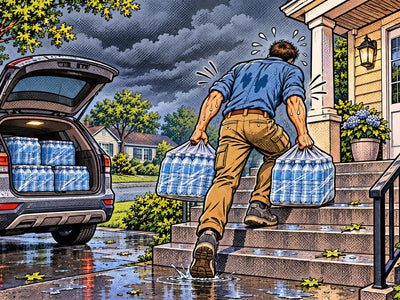
A family of four needs about 12 gallons to get through three days. That is roughly 100 pounds of water to have bought and stored.
With the radioA kit that weighs under a pound and any water source you can reach cover the gap.
Keep some bottles for the first hours. The kit is for everything after the last one.
Bottled water
0/4needs covered
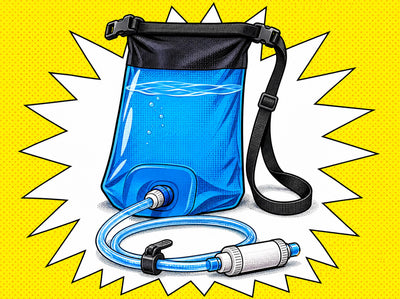
Gravity Water Filter Kit
4/4needs covered
BottlesAbout 12 gallons: roughly 100 lb to buy, carry and store.
KitOne kit under a pound that refills from the tub, a barrel or a stream.
BottlesRuns out, and the store shelf is usually empty too.
KitRated for up to 4,000 liters per filter, according to the manufacturer.
BottlesA closet shelf or a garage corner, rotated as the bottles age.
KitFolds flat into a drawer. Five-year shelf life stored dry.
BottlesAnother trip to the store, if it is open.
KitRefill from any source you can reach.
Tap a card to see what the guidance actually says.
Four situations where the tap is not the answer.
Water main break
A broken main or a failed pumping station can cut a whole neighborhood off for a day or more. The water you stored in the tub needs a clean way out.
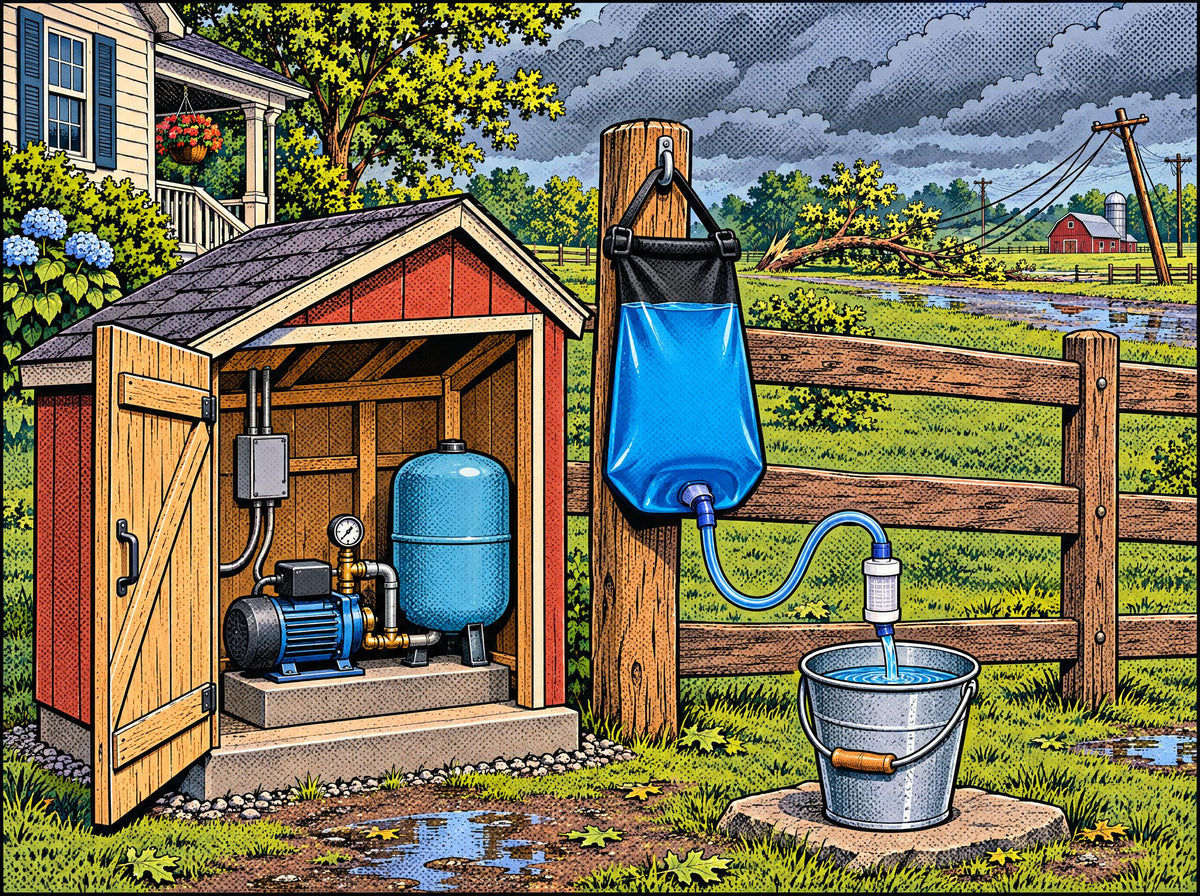
Well country
A private well stops with the electricity. The creek, the pond or the rain barrel becomes the backup source.
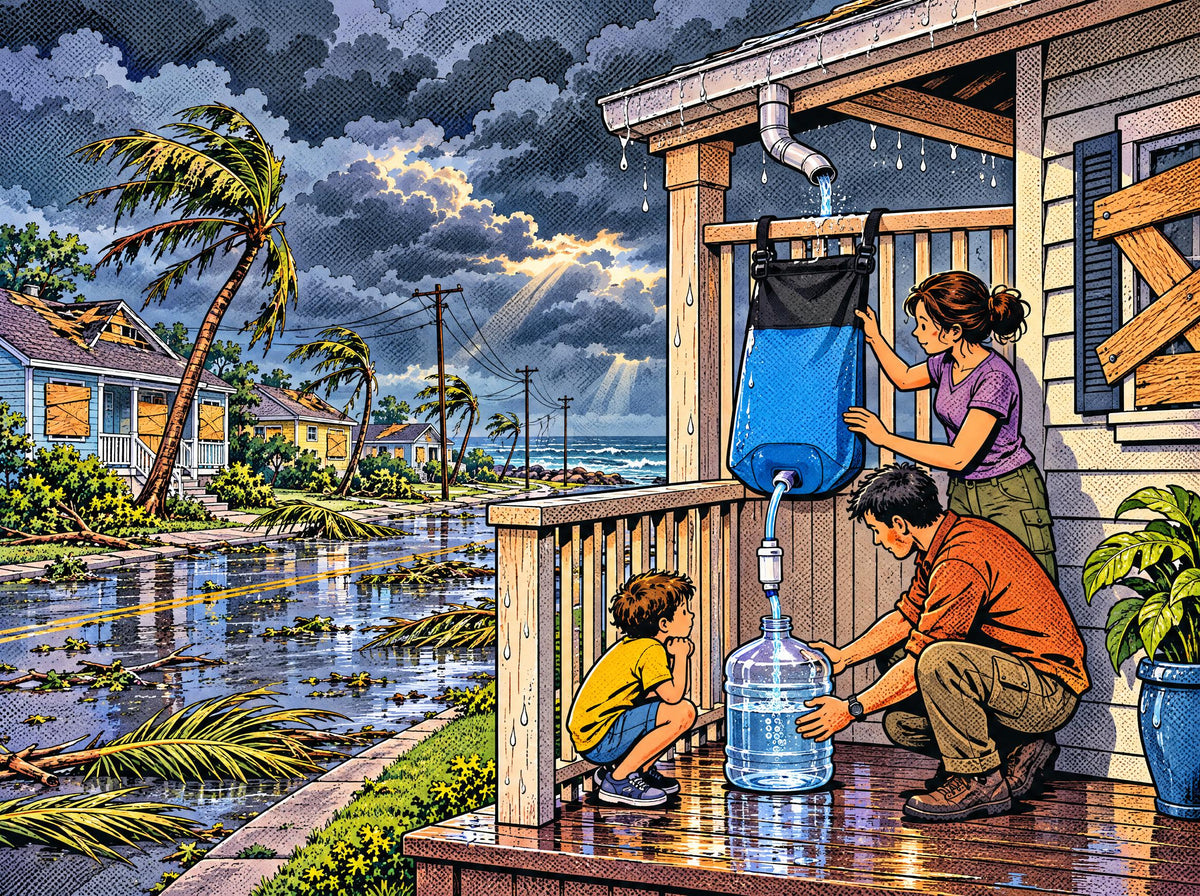
Hurricane week
After a big storm the grid and the water system can both be down for days. Collected rainwater goes through the filter first.
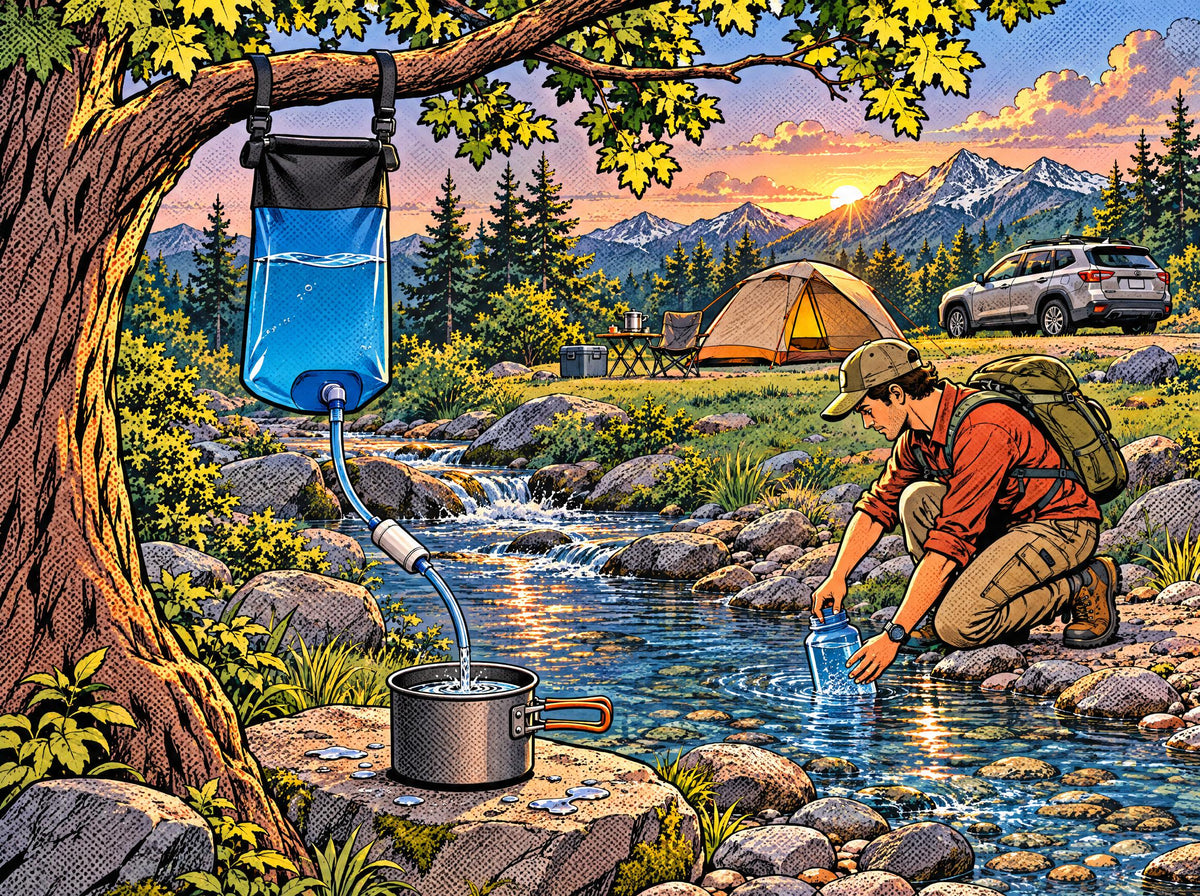
Off the grid
The same kit hangs from a branch at camp. One less case of bottles to pack.
72-Hour Blackout Plan
A filter gives you water. This 21-page guide covers the rest of the outage, from the first minute to the day the power comes back.
30 days
Try it at home. If it is not what you expected, send it back for a refund.
5-14 days
Every order ships with tracking, so you know where it is before you need it.
4,000 L
One filter element is rated for up to 4,000 liters. That is roughly 1,000 fills of the gallon bag.
The questions people ask before they buy, answered without the sales talk.
No. This filter is rated for bacteria (like E. coli and Salmonella) and protozoa (like Giardia and Cryptosporidium). It does not remove viruses, chemicals, heavy metals or salt. Use it with freshwater sources such as streams, rivers and rainwater.
Up to 4,000 liters according to the manufacturer, which is roughly 1,000 gallon bags. After that, replace the filter element.
The manufacturer rates the filter at 300 mL per minute, which is about 13 minutes per gallon bag with clear water. Cloudy water takes longer.
Yes. The kit filters water into whatever clean container you place below the hose outlet. A water bottle, a pot or a bucket all work.
The kit is designed for gravity filtration into a container. For drinking on the move, a squeeze or straw filter is a better match.
It is our own PDF guide. It covers what to store, what to do in the first hour and the first night, which food is still safe, and how to restart when the power comes back. It is based on public guidance from Ready.gov, the CDC and the USDA.
Orders arrive in 5 to 14 days with tracking. Order before you need it.
You have 30 days to return it for a refund.
The gravity-fed design is what appeals to me. No batteries to charge and no pump to keep working by hand.
3 people found this helpful
A folding bag makes a lot of sense for an emergency kit.
1 person found this helpful
I like the one-gallon capacity. It gives me a clear idea of how to plan bottle refills at camp.
4 people found this helpful
The hose clamp is a useful detail. Being able to stop the flow matters when switching between containers.
This looks like a practical option for a weekend campsite. I'd set it up alongside a separate collection container.
6 people found this helpful
Simple idea, practical format. The hanging bag is the main attraction for me.
2 people found this helpful
The bag folds flat, which is a big plus when the rest of the backpack is already full.
5 people found this helpful
I prefer this type of setup for base camp, where I can leave it hanging while organizing the rest of my gear.
3 people found this helpful
No charging cable, no spare batteries. That's a welcome feature in emergency equipment.
8 people found this helpful
The roll-top opening caught my eye. I like the design of the bag.
4 people found this helpful
Good concept for a shared campsite water station.
2 people found this helpful
I'd keep the bag, hose, and filter together in a pouch so all the pieces are easy to find.
7 people found this helpful
Glad a hanging strap is included. It's a small detail, but an essential part of this kind of setup.
9 people found this helpful
I like being able to collect filtered water in a separate container instead of drinking directly through a straw.
12 people found this helpful
This belongs on my camping checklist.
3 people found this helpful
The 3.8-liter capacity appeals to me for camp. I'd rather plan around a larger bag than constantly refill a small one.
6 people found this helpful
The biggest plus for me is that it works without electricity. That's a feature I look for in backup equipment.
14 people found this helpful
A gravity filter makes more sense to me for a settled campsite than a quick stop along the trail.
5 people found this helpful
I'd include this alongside stored drinking water in my household emergency supplies.
10 people found this helpful
Compact design, straightforward purpose. I like that combination.
4 people found this helpful
I appreciate equipment that packs down. Storage space at home matters to me just as much as backpack space.
8 people found this helpful
For quick trail stops, I prefer a bottle-based setup. For time around camp, a hanging gravity system is more appealing to me.
16 people found this helpful
Having the hose and hanging bag included makes this more interesting than buying a filter on its own.
7 people found this helpful
Nice option to consider for a cabin supply box.
5 people found this helpful
I'd find a suitable hanging spot before unpacking everything else. This setup takes a little planning, which is fine for camp.
13 people found this helpful
The no-pump design is the selling point for me.
9 people found this helpful
One gallon gives me a useful starting point for planning several bottle refills.
18 people found this helpful
The arrangement is easy to understand from the product photos.
6 people found this helpful
I'd pack a dedicated clean collection container with it.
11 people found this helpful
A thoughtful gift idea for someone building a camping kit.
8 people found this helpful
The folding bag interests me more than a rigid container.
15 people found this helpful
For group camping, I like a central refill spot.
21 people found this helpful
Gravity does the work. That's the main attraction.
7 people found this helpful
Clear limits: not rated for viruses, chemicals, heavy metals, or salt water.
25 people found this helpful
The bag's listed weight helps with packing plans.
12 people found this helpful
The included blackout planning guide is a nice addition.
17 people found this helpful
Could keep this in an emergency storage bin easily.
9 people found this helpful
I like having a hose between the bag and filter for flexibility.
14 people found this helpful
I'd practice assembling it at home before camping.
23 people found this helpful
The larger bag makes this interesting for camp use.
10 people found this helpful
The flow clamp is handy when moving from one bottle to the next.
19 people found this helpful
I'd consider a second kit for larger groups.
16 people found this helpful
I like camping gear with fewer things to charge.
8 people found this helpful
Part of my water plan, alongside stored drinking water.
28 people found this helpful
The wide opening stands out to me.
13 people found this helpful
For a relaxed camping weekend, allowing time for filtration is fine.
22 people found this helpful
Practical equipment to organize before a trip, not after arriving.
11 people found this helpful
The kit brings together the components I need: bag, hose, clamp, and filter.
31 people found this helpful
My emergency supplies already include lights. Water filtration covers a different part of the checklist.
20 people found this helpful
Simple, packable, and powered by gravity. Interesting combination.
26 people found this helpful
More from OutageReady
 Power and newsSIGNAL-R5 5-in-1 Emergency Crank RadioHand-crank and solar radio with NOAA weather band, flashlight and phone top-up.$69.90See the radio →
 WaterWATER-G1 Gravity Water Filter KitGravity-fed filter bag. No power needed, 0.01 micron ultrafiltration membrane.$69.90See the water kit →
 Carry and chargePOWER-P3 Solar Charging BackpackThree fold-out solar panels, a USB port on the side and room for a 15.6-inch laptop.$199.90See the backpack →
You cannot order clean water after the tap stops. Put the kit in a drawer this week and forget about it until the day you need it.
Choose your kitWATER-G1 Gravity Water Filter Kit, Family Pack30-day money-back guarantee
Choose your kit