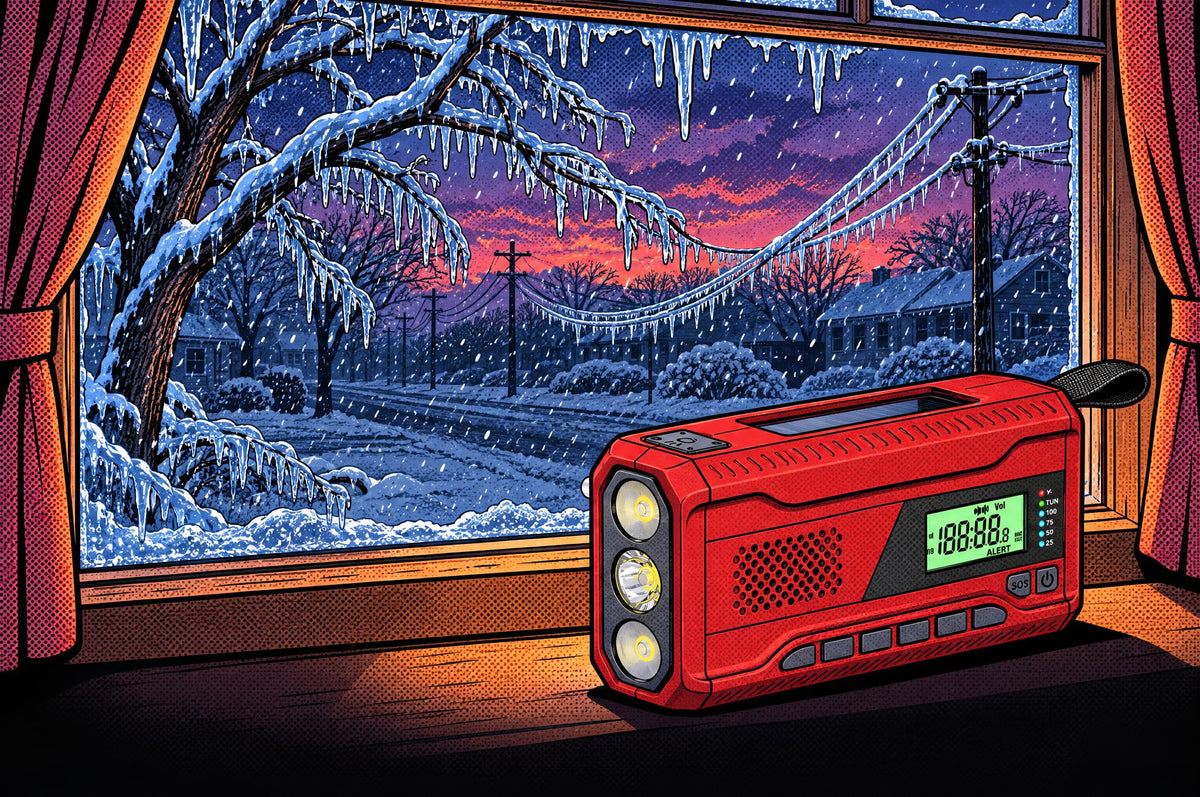
Winter storm
Ice on the lines
Power and heating go together. A radio tells you whether to stay put or get to a warming center before the roads close.

Light, news and power when nothing else in the house works.
 NOAA weather bandPlus AM and FM
 No outlet neededCrank, solar or USB-C
 Charges your phone4500mAh battery
 Lights the roomFlashlight and SOS alarm
How long the average U.S. home sat without power in 2024.
Source: U.S. Energy Information Administration, Dec 2025Delivered in 5 to 14 days, tracked.
Yes. AM, FM and the NOAA weather band are broadcast over the air. The radio needs no Wi-Fi, no SIM card and no cell signal.
Turn the hand crank or leave the solar panel in direct sun. Both are backup methods: the crank gives you light and radio right away, the panel tops the battery up slowly. Before a storm, charge it fully by USB-C.
Yes, over USB. It is built for an emergency top-up, enough for the calls and texts that matter. How much charge you get depends on the size of your phone battery.
They are extra rechargeable batteries included with the 2-battery kit and the Family Kit, so you have stored power in reserve before you ever touch the crank.
5 to 14 business days. Every order ships with tracking, sent to you by email.
You have 30 days from delivery to return it for a refund. The full steps are in our Refund and Return Policy.
Charge it by USB-C before the storm. Once the grid is down, the radio has two ways to keep itself going. The bars compare their charging current.
Manufacturer specification
Manufacturer specification
When the battery is flat and the sky is dark, your arm is the power plant. Unfold the crank and turn. No outlet, no sun, no spare batteries.
Estimate based on the manufacturer's figures: 400 mA crank output and 30+ hours of radio on the 4500 mAh battery. Actual time varies with cranking speed and volume.
None of these are ours. They come from the agencies that plan for this.
4
hours
How long an unopened refrigerator keeps food safe without power.
USDA / CDC
48
hours
How long a full freezer holds its temperature. Half full: 24 hours.
USDA / CDC
1
gallon a day
The water to store for each person, for several days.
Ready.gov
20
feet
The minimum distance between a running generator and any window, door or vent.
CDC
Tap a number. Every one of them works with the grid down.
01 / 06
AM, FM and the NOAA weather band. The stations that carry official warnings stay on air when your feed stops refreshing.
02 / 06
A bright flashlight on the end and a reading lamp for the room. Enough to cook, find the stairs and keep the kids calm.
03 / 06
Leave it on a windowsill and the panel trickles charge into the battery. It is slow, and it is meant as backup, but the sun does not send a bill.
04 / 06
Turn the crank and the radio and light come back to life. No outlet, no fuel, no batteries to hunt for in a dark drawer.
05 / 06
The 4500mAh battery can push emergency charge into your phone over USB. Enough for the calls and texts that matter.
06 / 06
A loud alarm and flashing light to signal for help if someone is hurt or trapped.
No mystery box. Here is what is inside and what it does.
| Radio bands | AM, FM and the NOAA weather band |
|---|---|
| Battery | Built-in rechargeable lithium cell (21700), 4500mAh. No disposable batteries needed |
| Three ways to charge | USB-C, hand crank (400mA), solar panel (70mA) |
| Running time | More than 30 hours of radio or light on a full battery, according to the manufacturer |
| Light | 3W flashlight and reading light |
| Phone charging | USB output for emergency phone charge |
| Alarm | SOS alarm |
| Display | LCD display |
| Size and weight | 15 x 7.5 x 4 cm, 300 g, with carry strap |
| Tuning | Manual tuning with station scan, frequency shown on the LCD |
| Speaker | Built-in speaker |
| Charging input | 5V over USB-C. Cable included |
| Body | ABS plastic with wrist lanyard |
| Model | WR-6A |
There is nothing to install and nothing to learn. This is the whole routine.

Before
Plug it in by USB-C when the forecast turns bad, then leave it somewhere every person in the house can find without a light.

During
Switch on the flashlight, then tune to a local station or the NOAA weather band to hear what is happening and how long it may last.

If it drags on
When the battery runs low, turn the crank or leave the panel in daylight. Save phone charging for the calls and messages that matter.
An outage is not one problem. It is a new problem every few hours. Tap through the first three days.
Lights, the Wi-Fi router, the TV and any cordless phone stop at once. Your mobile is now running on whatever charge it happened to have.

With the radioThe flashlight is on in one click, and the radio is already tuned to a local station.
The USDA rule of thumb: an unopened refrigerator keeps food safe for about four hours. Meanwhile everyone is calling everyone, and mobile networks slow to a crawl.
With the radioYou hear what the utility and local officials are saying without burning phone battery on a loading screen.
A phone used for light, calls and news all day is close to empty. After sunset the house is as dark as the street.
With the radioCrank it or use the stored charge to put emergency power back into your phone, and keep the reading light on for the room.
Is it the whole county? Is water safe? Are shelters open? Card readers and cash machines need power too, so stores that open may be cash only.
With the radioAM, FM and the NOAA weather band keep broadcasting on backup power. That is the channel emergency plans are built around.
Official preparedness guidance is built around a household looking after itself for the first few days. Past that point, the prepared and the unprepared are living two different outages.
With the radioThe crank and the solar panel mean the radio and the light never depend on a battery you forgot to buy.
It is the first thing you reach for and the first thing to quit. Here is what each one does once the outlets are dead.
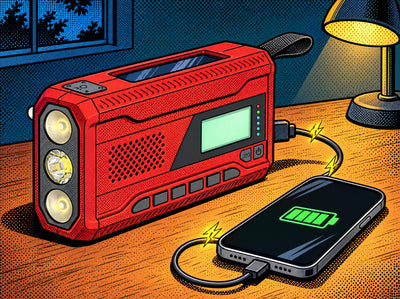
A phone on its last charge
0/4needs covered
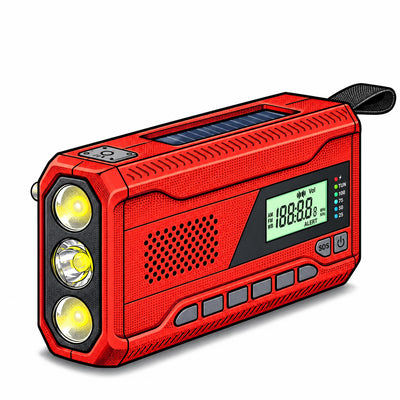
The radio
4/4needs covered
PhoneNeeds a working cell network and data. Both get jammed when everyone is online at once.
RadioPulls AM, FM and NOAA weather broadcasts straight from the air.
PhoneThe phone flashlight drains the same battery you need for calls.
RadioDedicated flashlight and reading lamp on their own battery.
PhoneDead, unless you own a charged power bank.
RadioCrank it. Or leave it in the sun.
PhoneOnly if there is signal and charge left.
RadioSOS alarm and light, plus charge to revive your phone.
Tap a card to see what the guidance actually says.
Different causes, same problem: no light, no news, no charge.
Winter storm
Power and heating go together. A radio tells you whether to stay put or get to a warming center before the roads close.
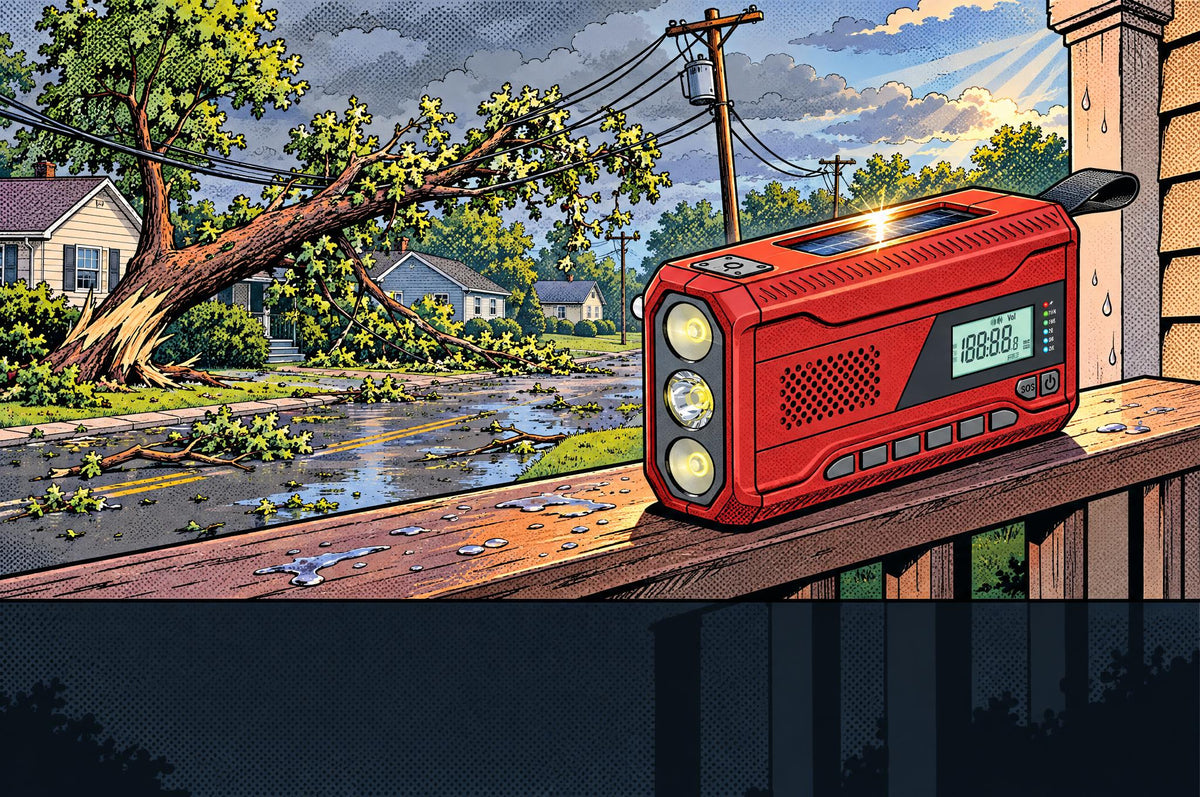
Hurricane season
After a major storm, restoration can take a long time. This is where a crank and a solar panel earn their place.
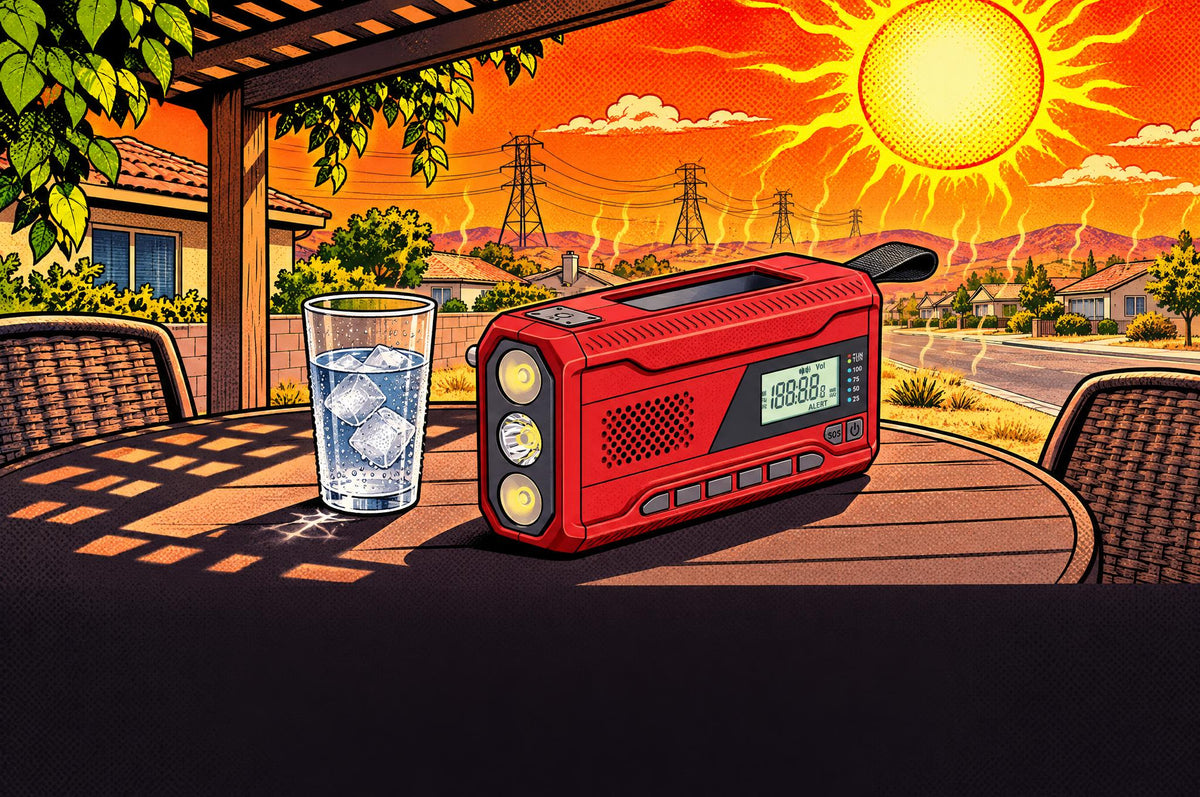
Heat wave
Outages during extreme heat can come with little notice. Know where the cooling centers are before your phone dies.
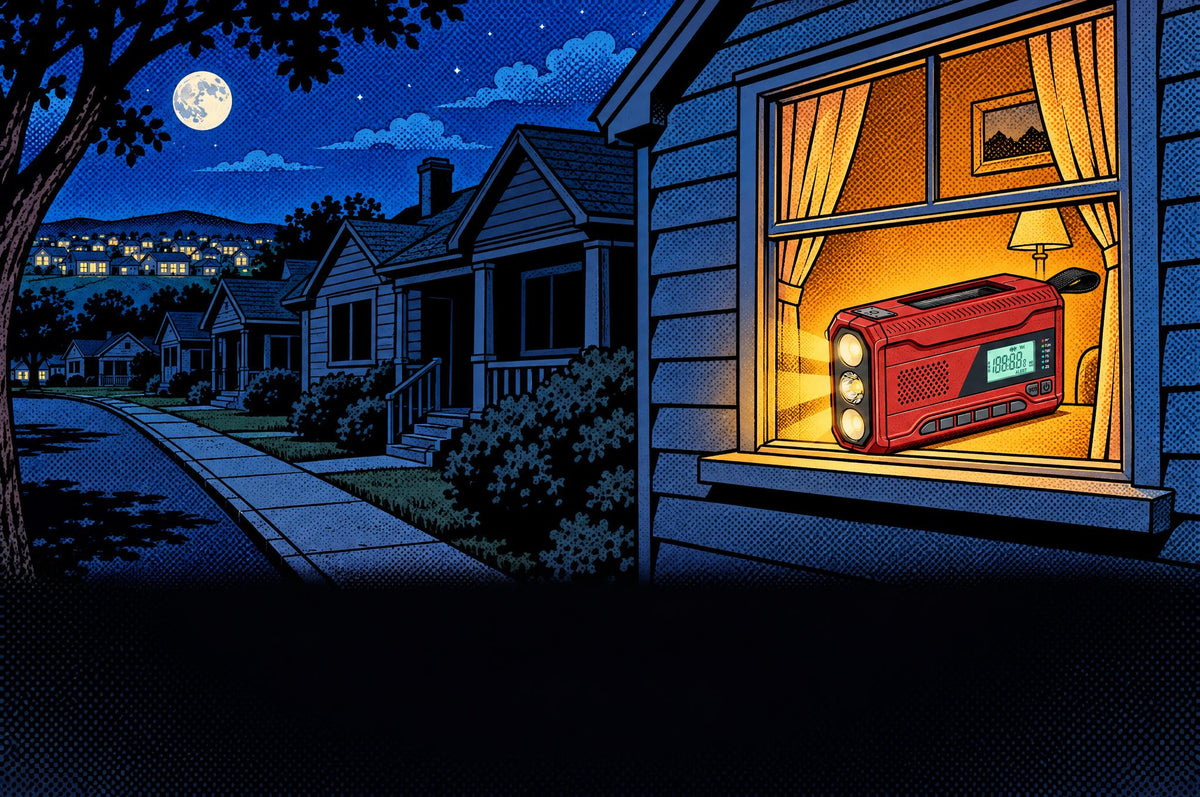
Any ordinary night
Most outages are local and unannounced. The house that is ready barely notices.
72-Hour Blackout Plan
A radio tells you what is happening. This 21-page guide tells you what to do about it, from the first minute to the day the power comes back.
30 days
Try it at home. If it is not what you expected, send it back for a refund.
5-14 days
Every order ships with tracking, so you know where it is before you need it.
3 ways
USB-C before the storm, the hand crank during it, the solar panel after it.
The questions people ask before they buy, answered without the sales talk.
Yes. AM, FM and NOAA weather broadcasts come over the air. The radio does not use a mobile network, Wi-Fi or an app.
The crank is there to keep the radio and the light going for short stretches when nothing else is available. For a full battery, charge it by USB-C before bad weather. Treat the crank and the solar panel as backup, not as the main charger.
It is built to put emergency charge into a phone, enough for calls and texts. It is not a replacement for a large power bank.
No. It has a built-in rechargeable battery that you recharge by USB-C, the hand crank or the solar panel.
They are extra rechargeable batteries of the type the radio uses. They give you stored power in reserve, so a long outage does not depend on the crank or the sun alone.
No. It works like a simple kitchen radio: switch it on, choose the band, tune the station.
Yes, and you should now and then. Using it for the news or a ball game is the easiest way to know it is charged and working.
AM and FM work wherever stations broadcast. The NOAA weather band is a United States service.
It is our own PDF guide. It covers what to store, what to do in the first hour and the first night, which food is still safe, and how to restart when the power comes back. It is based on public guidance from Ready.gov, the CDC and the USDA.
Orders arrive in 5 to 14 days with tracking. Order before you need it. An outage is the one time next-day delivery does not exist.
You have 30 days to return it for a refund.
The hand crank is what caught my attention. Having another way to power a radio makes sense for an emergency kit.
2 people found this helpful
Radio, flashlight, and backup phone power in one place. Practical combination for a blackout kit.
AM and FM alongside the weather band. More listening options without depending on internet.
3 people found this helpful
Exactly the kind of practical item I would keep with my emergency supplies.
1 person found this helpful
USB-C for charging and a crank for backup. Fits the way I prepare for outages.
5 people found this helpful
The reading light is a thoughtful extra. A flashlight isn't always the light you want at a table.
2 people found this helpful
A sensible addition to a go-bag. Several useful features without packing separate devices.
4 people found this helpful
The solar panel interests me as a backup. I'd still charge by USB-C before packing.
1 person found this helpful
I prefer emergency gear that doesn't need an app. A standalone radio suits me.
7 people found this helpful
Having the frequency on a display is a nice touch.
3 people found this helpful
The carry strap is a small detail I appreciate on portable equipment.
Covers several things on my emergency checklist: radio, lighting, and backup phone charging.
6 people found this helpful
Emergency phone charging is a useful extra. I'd save that power for essential calls.
9 people found this helpful
Nice mix of everyday radio functions and emergency features. Doesn't have to sit unused.
4 people found this helpful
The crank would be my backup option. Keeping the battery charged beforehand is the best approach.
11 people found this helpful
AM/FM, a light, and a rechargeable battery. The basics I want in a backup radio.
2 people found this helpful
The compact dimensions appeal to me. Emergency supplies can take up a lot of cupboard space.
8 people found this helpful
I'd keep this beside the household emergency supplies so everyone knows where to find it.
5 people found this helpful
The reading lamp caught my eye. Useful for evenings away from an outlet.
3 people found this helpful
A radio that doesn't depend on Wi-Fi belongs on my preparedness list.
12 people found this helpful
Would fit nicely into my camping checklist. Lighting and radio together.
6 people found this helpful
A built-in speaker matters. I'd want everyone in the room to hear the broadcast.
14 people found this helpful
Glad the solar panel is described as a slow backup. Sets sensible expectations.
4 people found this helpful
I'd make room for this in a cabin supply box. The crank is appealing for trips away from wall outlets.
9 people found this helpful
A rechargeable radio suits my setup better than another device needing disposable batteries.
7 people found this helpful
The SOS alarm is an extra feature I'd learn to operate before packing.
15 people found this helpful
My supply box has cables but no radio. This fills the gap.
5 people found this helpful
Flashlight and reading light serve different purposes. Both belong in a blackout kit.
18 people found this helpful
Several practical features in one portable unit.
8 people found this helpful
A thoughtful gift for someone building their first emergency kit.
10 people found this helpful
I'd use the FM radio between trips. Good to keep emergency equipment within reach.
16 people found this helpful
Three charging options are the main attraction for me.
3 people found this helpful
The listed 300 g weight helps with packing decisions.
21 people found this helpful
I'd rather have a separate light than use my phone flashlight.
12 people found this helpful
The weather band feature I'd check first.
7 people found this helpful
Small apartment. A multi-function radio is appealing for my emergency shelf.
19 people found this helpful
Charging cable included. One less item to add to the packing list.
9 people found this helpful
Keep it charged and somewhere easy to reach.
24 people found this helpful
The reading light gives this camping appeal.
13 people found this helpful
Good mix for an emergency bag. Hand crank is welcome.
6 people found this helpful
Small solar panel as an extra option makes sense to me.
27 people found this helpful
A portable radio lets me listen to broadcasts while keeping my phone free.
17 people found this helpful
Wrist strap is handy when carrying gear.
11 people found this helpful
Station scan plus frequency display. Useful for finding a broadcast.
30 people found this helpful
Something to have ready before weather turns bad.
15 people found this helpful
Phone charging is a bonus. Radio and lights are the main reasons.
22 people found this helpful
Weekend cabin trip companion. Radio time beats phone all evening.
8 people found this helpful
The included blackout guide is useful. Equipment and planning should go together.
34 people found this helpful
Light and radio together makes the kit easier to organize.
20 people found this helpful
Broadcast radio, two types of light, several ways to recharge. Practical.
26 people found this helpful
More from OutageReady
 Power and newsSIGNAL-R5 5-in-1 Emergency Crank RadioHand-crank and solar radio with NOAA weather band, flashlight and phone top-up.$69.90See the radio →
 WaterWATER-G1 Gravity Water Filter KitGravity-fed filter bag. No power needed, 0.01 micron ultrafiltration membrane.$69.90See the water kit →
 Carry and chargePOWER-P3 Solar Charging BackpackThree fold-out solar panels, a USB port on the side and room for a 15.6-inch laptop.$199.90See the backpack →
You cannot order light in the dark. Put the radio on the shelf this week and forget about it until the night you need it.
Choose your kitSIGNAL-R5 Family Kit: 2 Radios + 4 Spare Batteries30-day money-back guarantee
Choose your kit